Can a Freckle Be Raised?
Quick Summary
- True freckles are typically flat; a “raised freckle” is often a mole, sun spot (solar lentigo), seborrheic keratosis, or irritation affecting the skin’s surface.
- Freckles are small tan-to-light-brown pigment spots linked to genetics and UV exposure, often darkening in sunny months and fading with less sun.
- Raised or textured freckle-like spots should be watched for change: growth, uneven color, irregular borders, crusting/bleeding, or new itching/pain.
- A simple home check includes the “finger test” (if your fingertip catches, it’s less likely a true freckle) and monthly photos in consistent lighting to track changes.
- If a spot is new, becoming raised, changing, or looks like an “odd one out,” a dermatology exam may include visual and dermatoscope evaluation, with biopsy only if needed.
Yes, a spot that looks like a freckle can be raised, but true freckles are typically flat. When someone says “a raised freckle,” they are often describing a mole, a sun spot, or another pigmented growth that is sitting above the skin surface. The key is not the label. It is whether the spot is new, changing, symptomatic, or simply looks different than the rest of your marks.
If you are in Seattle and you notice a freckle-like spot that is becoming raised over time, it is reasonable to get it checked, especially if it is changing in size, shape, color, or sensation.
Understanding Freckles

Freckles are common, often harmless, and strongly linked to genetics and sun exposure. Knowing what freckles usually look like makes it easier to spot when something is acting unlike a typical freckle.
What are freckles?
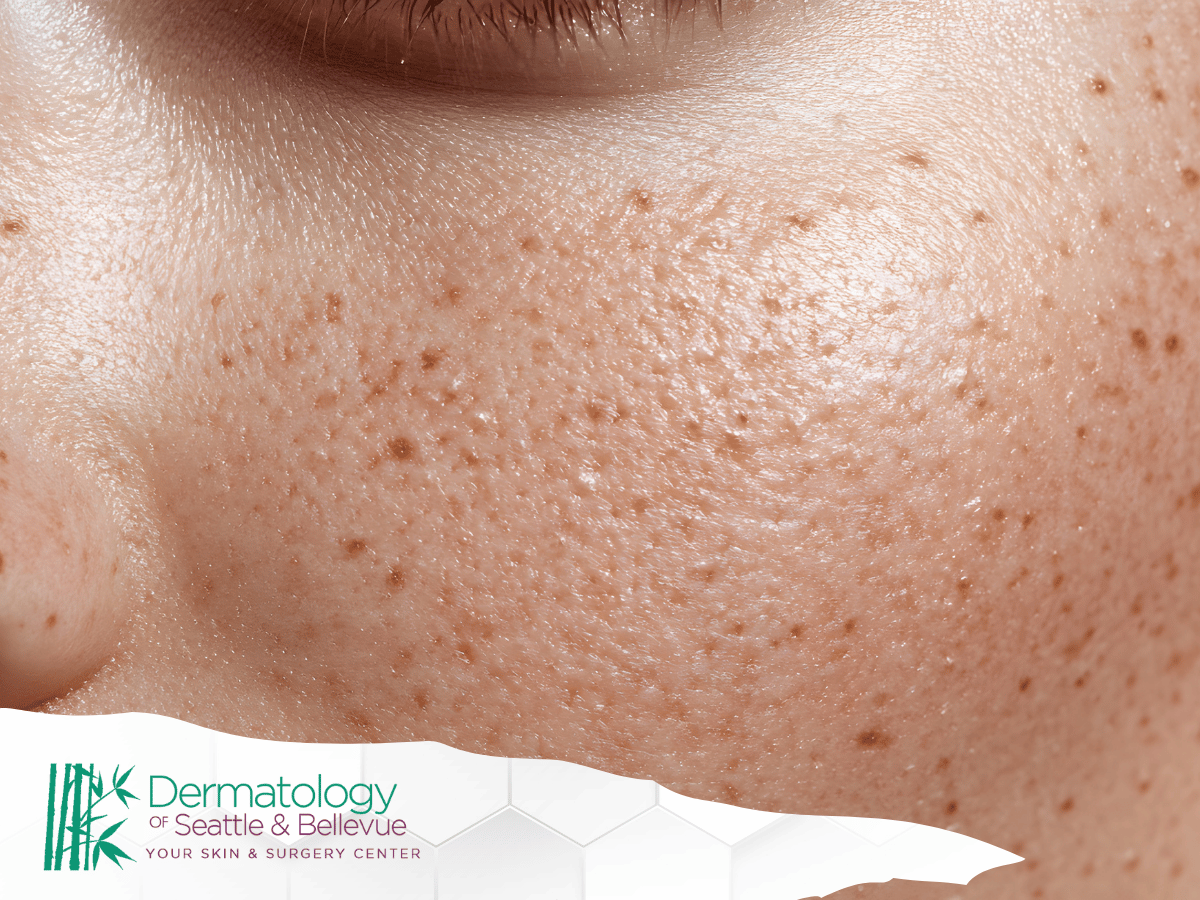
Freckles are small, light-to-medium brown spots caused by increased pigment (melanin) in the skin. They usually appear on sun-exposed areas like the face, shoulders, arms, and upper back. Unlike many moles, freckles do not come from a cluster of pigment-producing cells forming a growth. They are more like “pigment dots” that show up when the skin responds to ultraviolet exposure.
Most freckles are:
- Flat
- Small and evenly colored
- More noticeable in sunny months
- Less noticeable in winter or with strict sun protection
Causes of freckles
Freckles form from a mix of genetics and sun exposure. Some people are simply more likely to freckle, especially those with lighter skin tones. UV exposure then triggers pigment production, making freckles darker and more visible.
Common factors that contribute to freckles include:
- Genetics and skin type
- Repeated sun exposure, including incidental daily exposure
- Childhood and teen years, when freckles often first appear
- Tanning (outdoors or indoor tanning)
Even in cloudy climates like Seattle, UV rays still reach the skin, and cumulative exposure can influence freckles and other pigmented spots over time.
Types of freckles
People often use “freckle” to describe different types of brown spots. In dermatology, freckles are usually grouped into a couple of common categories:
Ephelides (classic freckles)
These are the small, light brown spots that tend to darken with sun exposure and fade when sun exposure drops. They often show up in childhood and can become less noticeable with age and consistent sun protection.
Solar lentigines (sun spots or age spots)
These are darker, more persistent spots caused by long-term sun exposure. They tend to appear later in life and do not fade as much seasonally. Many people call these freckles, but they behave differently.
While both are usually flat, sun spots can sometimes look slightly textured depending on what else is happening in the skin (like dryness, thickening, or overlapping benign growths).
Can a Freckle Be Raised?
If we are talking about a true freckle, it is usually flat. If a freckle-like spot feels raised, it may not be a freckle at all, or it may be a freckle sitting on top of another skin change. What matters most is whether the spot is stable and looks like your other typical pigment marks, or whether it is evolving.
Characteristics of raised freckles
When people describe a raised freckle, a few common scenarios are often behind it:
A mole that looks like a freckle
Many moles are light brown and small, especially early on. Some remain flat, but others become raised over time.
A seborrheic keratosis (a common benign growth)
These can start as faint tan spots and gradually become thicker, waxy, or “stuck-on” in appearance.
A sun spot with surface change
The pigment may be flat, but the surface can feel uneven if there is dryness, mild thickening, or irritation.
Inflammation or irritation
Scratching, acne-like bumps, eczema patches, or healing skin can temporarily change texture around a pigmented spot, making it feel raised.
A more concerning change
A spot that is raised and changing, irregular, or symptomatic should be evaluated to rule out atypical lesions or skin cancer.
Bottom line: a raised brown spot is more likely to be a mole or another growth than a classic freckle. That does not automatically mean it is dangerous, but it does mean it deserves a clearer look.
How to identify raised freckles
Start with a simple, practical check at home. You are not trying to diagnose. You are trying to decide whether this looks stable and familiar or different enough to warrant a dermatology visit.
Helpful questions to ask:
- Has this spot always been raised, or is it becoming raised over time?
- Does it look like your other freckles, or does it stand out?
- Has the color changed, darkened, or become uneven?
- Has the border become irregular or blurry?
- Has it grown quickly or started to crust, bleed, or scab?
- Does it itch, hurt, or feel tender without a clear reason?
A quick “finger test” can also help: freckles are typically felt more than they are. If your fingertip clearly catches on it, it is more likely a mole, seborrheic keratosis, or another raised lesion.
If you want to track changes, take a clear photo in consistent lighting once a month and compare. In a place like Seattle where seasons can change sun exposure patterns, photos can help you notice real changes versus normal shifts in visibility.
Difference Between Moles and Freckles

The difference between moles and freckles is one of the most common sources of confusion. Many benign spots overlap in color and location, and people may use “freckle” as a catch-all term. Understanding the basic differences helps you communicate clearly with a dermatologist and notice changes earlier.
Freckle vs. mole: basic distinctions
Freckles:
- Typically flat
- Often smaller and more uniform
- More likely to darken with sun exposure and lighten with less sun
- Usually appear in childhood or early adulthood
Moles:
- Can be flat or raised
- May be present from childhood or appear over time
- Often stay more consistent year-round compared with freckles
- Can vary more in size, shape, and color
If your question is “can a freckle be raised,” the freckle vs mole distinction is central. Raised brown spots are more often moles or other benign growths than true freckles.
Differences in moles and freckles: color and texture
Color:
Freckles usually have a more uniform tan-to-light-brown color. Moles can be tan, brown, dark brown, or even skin-colored, and some can have multiple shades.
Texture:
Freckles are usually smooth because they are flat pigment changes. Moles may feel smooth or slightly bumpy. Some become more raised with time. Other benign growths can feel waxy, rough, or “stuck on.”
Pattern:
Freckles often appear in clusters on sun-exposed skin and can look like a “sprinkle” pattern. Moles may be scattered and can appear in both sun-exposed and less exposed areas.
If you notice a difference in moles and freckles on your skin, focus on which spots are stable and familiar versus which ones are changing, symptomatic, or visually distinct from the rest.
Beauty mark vs. freckle: are they the same?
Not usually. A “beauty mark” is a casual term that most often refers to a mole. Freckles and moles can both be considered beauty marks in everyday conversation, but medically they are different categories of lesions.
If you are comparing beauty mark vs freckle, think of it this way:
- A freckle is usually a flat pigment spot that fluctuates with sun exposure.
- A beauty mark is often a mole, which may be flat or raised and tends to be more stable throughout the year.
When describing a spot to a dermatologist, it is better to describe what you see and feel rather than relying on the label. For example: “small light brown spot, slightly raised, has been changing over six months.”
When to Seek Medical Advice
A raised freckle-like spot is not automatically an emergency, but it is a valid reason to schedule a professional skin evaluation, especially if it is new or changing. Dermatologists in Seattle see many sun-related skin changes, and early evaluation is often the simplest way to get clarity and peace of mind.
Signs that a freckle needs evaluation
Consider scheduling a dermatology visit if you notice any of the following:
- A spot that is becoming raised over time
- A change in size, shape, or color
- Uneven color, especially multiple shades in one lesion
- Irregular borders or a spreading edge
- Bleeding, crusting, scabbing, or not healing normally
- New pain, tenderness, or persistent itching
- A spot that looks different from others on your body (the “odd one out”)
Even if the spot turns out to be benign, getting it checked can create a baseline and reduce uncertainty. This is especially useful if you have a history of significant sun exposure, blistering sunburns, tanning bed use, or a personal or family history of skin cancer.
Importance of early detection
Early detection matters because many skin cancers are highly treatable when found early. The goal is not to assume the worst. The goal is to catch concerning changes sooner rather than later, when evaluation and treatment are often simpler.
A common misconception is that only dark, dramatic spots are concerning. In reality, changes in a lesion, including becoming raised, developing irregular edges, or changing sensation, can be meaningful even if the color is subtle.
If you are asking “what does it mean if a freckle becomes raised over time,” the safest answer is: it means the spot deserves a closer look so it can be correctly identified.
What to expect during a dermatological examination

A dermatology visit for a raised freckle-like spot is typically straightforward:
Visual exam
The clinician will look at the spot closely and often compare it to other marks on your skin.
Dermatoscope exam
A dermatoscope is a specialized lighted magnifier that helps evaluate pigment patterns and structures beneath the surface. This adds detail beyond what the naked eye can see.
Full skin exam (sometimes recommended)
Depending on your history and risk factors, the clinician may recommend a broader check of your skin.
Biopsy (only if needed)
If the spot looks suspicious or unclear, a small sample may be taken and sent to a lab. A biopsy is the definitive way to identify many lesions. Most biopsies are quick and done with local numbing medicine.
You do not need to wait until a spot becomes “really bad” to get it looked at. If something is changing, new, or worrying you, that alone is a reasonable reason to book an exam.
Conclusion
So, can a freckle be raised? In most cases, true freckles are flat. If a freckle-like spot is raised, it is more likely to be a mole, a benign growth, or another type of pigmented lesion. The practical approach is to focus less on the label and more on change: new, evolving, symptomatic, or “odd one out” spots should be evaluated by a dermatologist.
Disclaimer
This article is for general educational purposes only and does not provide medical advice, diagnosis, or treatment. If you have a raised, changing, symptomatic, or concerning skin spot, schedule an evaluation with a qualified healthcare professional.