Sun exposure can leave marks on the skin that are harmless, but it can also contribute to changes that need medical attention. If you have ever wondered what does sun spots look like in real life, the answer is usually a flat, evenly colored patch that develops slowly over time, often on areas that see frequent sun. The challenge is that some early skin cancers can also appear as new or changing spots. In this guide, you will learn how sun spots typically look, where they show up, and how they differ from skin cancer. You will also learn practical warning signs to watch for and when it is worth booking a dermatology visit.
- Sun spots are usually flat, uniform in color, and slow to change.
- Skin cancer spots are more likely to change, bleed, crust, or have irregular borders.
- Location matters, but any changing spot anywhere on the body deserves attention.
- Use simple self-check routines to track new or evolving marks.
- When in doubt, a dermatologist can assess whether it is a sunspot or skin cancer.
Introduction
Many people notice new freckles, patches, or “age spots” after years of outdoor time, and it is normal to feel unsure about what you are seeing. Sun-related pigmentation is common and often harmless, but skin cancer can start subtly, sometimes resembling a harmless mark at first glance. Learning basic visual patterns can help you respond appropriately without panic or delay.
The Importance of Distinguishing Sun Spots from Skin Cancer
Distinguishing a typical sun spot from a suspicious lesion matters because the next steps are different. Sun spots often require no medical treatment unless you want them faded for cosmetic reasons. By contrast, skin cancer needs professional evaluation and may require removal or other treatment. Confusion is common, especially when people search phrases like sun spots vs skin cancer or cancerous sun spots, because the words “spot” and “sun” get used broadly. The goal is not to self-diagnose, but to recognize what looks stable versus what looks unusual, evolving, or symptomatic.
Understanding Sun Spots
Sun spots, sometimes called age spots or liver spots, are areas of increased pigmentation caused by cumulative ultraviolet exposure. They tend to appear gradually and become more noticeable over time. For many people, they are simply a sign that the skin has been “keeping score” of sun exposure.
In most cases, sun spots are benign. They are typically not painful, not raised, and not associated with bleeding or scabbing. Still, any pigmented area can coexist with other skin changes, so it helps to know the classic features and what would be considered outside the usual pattern.
Definition and Characteristics
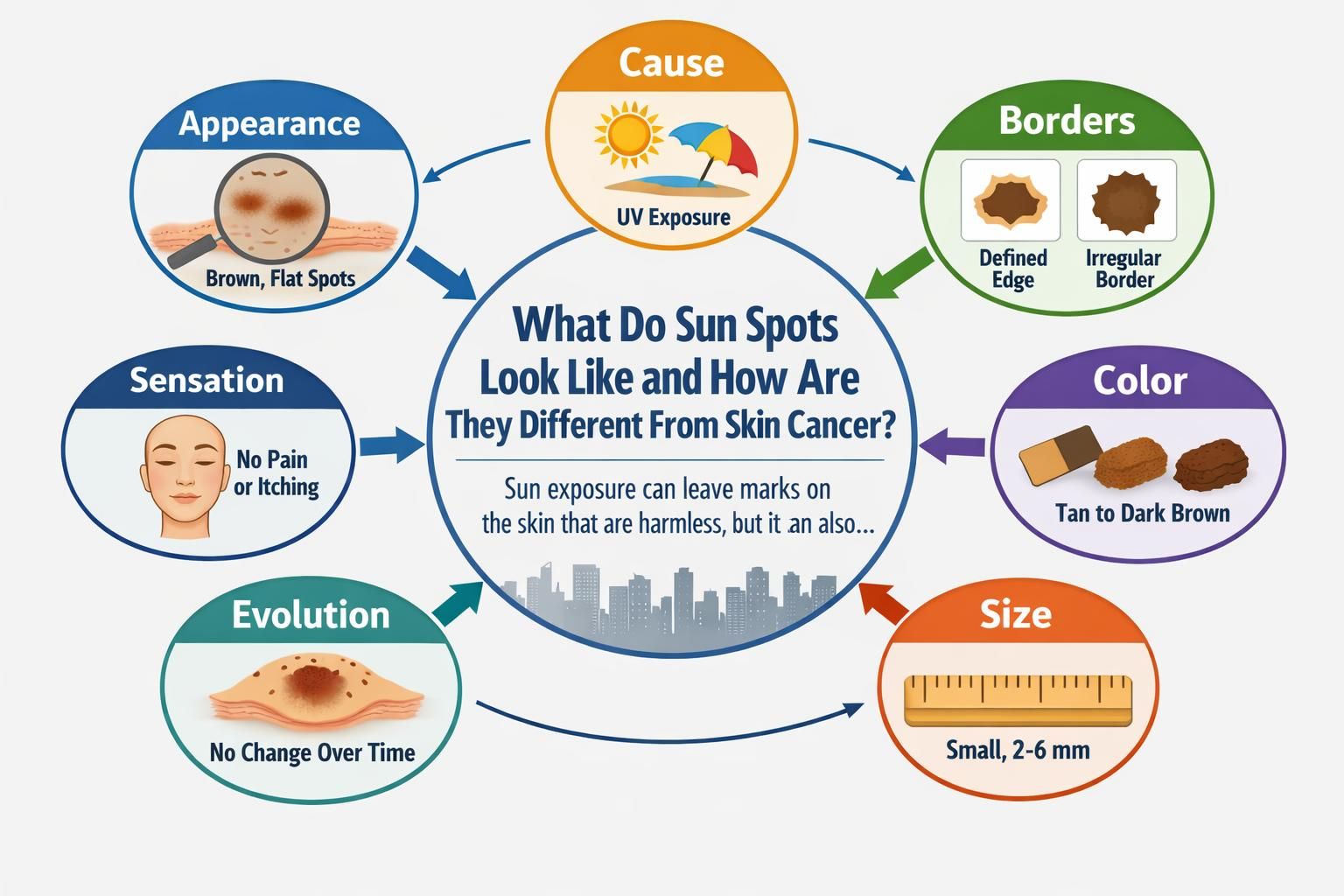
A sun spot is a localized area where pigment-producing cells have made extra melanin after repeated sun exposure. The result is a patch that looks darker than the surrounding skin. Sun spots usually:
- Are flat and smooth, matching the skin’s texture
- Develop slowly over months or years
- Stay relatively consistent in size and color
- Do not itch, hurt, or bleed under normal conditions
Because they are tied to sun exposure patterns, they often cluster in areas that are routinely uncovered. They can appear in people of many skin tones, though the contrast and visibility may differ.
Appearance: Color, Size, and Shape
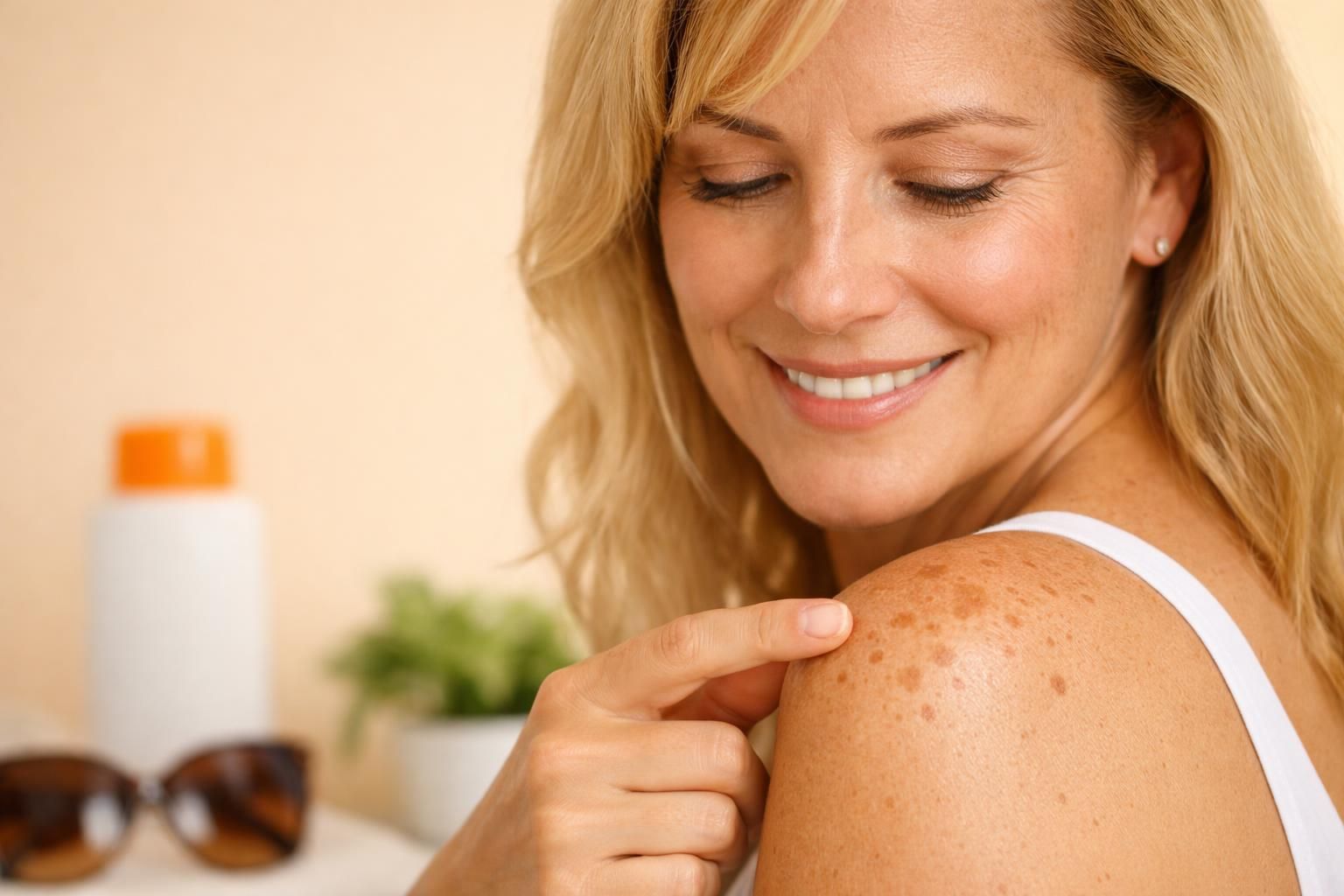
When people ask what does sun spots look like, the most common description is a tan to medium-brown patch with fairly even coloring. Some may look light brown, darker brown, or slightly gray-brown depending on skin tone and depth of pigment. The shape is often round, oval, or softly irregular, but the edges are usually fairly well-defined.
Size can range from freckle-sized to larger patches. Importantly, the surface typically remains flat rather than scaly or crusted. If a spot becomes raised, develops a mixed palette of colors, or starts changing quickly, that is a reason to think beyond a simple sun spot and consider evaluation.
Common Locations on the Body
Sun spots typically appear on places that get the most cumulative sun. Common areas include the face, backs of the hands, forearms, shoulders, upper chest, and upper back. These are the “high exposure” zones where ultraviolet light regularly hits the skin.
That said, not every spot in a sunny area is automatically a sun spot, and not every suspicious lesion appears only in sun-exposed locations. For that reason, location should be used as a clue, not a verdict. It is also worth checking the scalp (especially along part lines), ears, and the backs of the legs, where sun exposure can be frequent and changes are easy to miss.
Skin Cancer Overview
Skin cancer is a broad term for abnormal growth of skin cells. It can show up as a new spot, a changing mole, a sore that does not heal, or a patch that looks different from everything else on your skin. Because the appearance can vary widely, people sometimes describe melanoma sun spots on skin or cancer sun spots skin when they notice a dark patch and worry about worst-case scenarios.
Not all skin cancers are deeply pigmented, and not all pigmented spots are cancer. The key is to pay attention to change over time and to features like irregularity, symptoms, and breakdown of the skin surface.
What is Skin Cancer?
Skin cancer happens when skin cells grow in an uncontrolled way. Sun exposure can be a major contributing factor, but skin cancer can develop for other reasons as well. Some forms grow slowly and stay local, while others can be more aggressive. Early detection generally makes treatment simpler, which is why suspicious changes should be checked rather than watched indefinitely.
A practical way to think about skin cancer is that it often behaves differently than a stable, “quiet” sun spot. It may evolve, feel different, or look unlike your other marks. A spot that stands out as the odd one out deserves extra attention.
Types of Skin Cancer Relevant to Sun Spots
Several skin cancers can be confused with sun-related discoloration, especially in early stages. The ones most often discussed in sun spot comparisons include:
- Melanoma: often pigmented and more likely to show multiple colors, asymmetry, or rapid change
- Basal cell carcinoma: may look like a pearly bump, a non-healing sore, or a pink patch, sometimes with visible small vessels
- Squamous cell carcinoma: may appear as a scaly or crusted patch, a thickened area, or a sore that can bleed
Because appearances overlap, online categories like sunspot or skin cancer are understandable, but they cannot replace an exam. A clinician can use tools and, if needed, a biopsy to determine what the spot truly is.
Recognizing Cancerous Sun Spots
People often use the phrase cancerous sun spots to describe any dark spot that seems suspicious. While a true sun spot is benign, a concerning lesion may mimic one. Warning signs that a spot might not be a simple sun spot include noticeable evolution over weeks to months, irregular borders, multiple colors in one lesion, or symptoms like itching, tenderness, bleeding, or crusting.
Also watch for a spot that becomes raised when it used to be flat, or a patch that looks scar-like, shiny, or persistently inflamed. If you are tracking melanoma sun spots on skin concerns, focus less on the label and more on whether the spot is changing, symptomatic, or visually unpredictable.
Differences Between Sun Spots and Skin Cancer
Sun spots and skin cancer can both appear after years of sun exposure, which is why the distinction can feel tricky. A helpful approach is to compare stability versus change. Sun spots tend to be consistent in their look and behavior. Skin cancers, especially melanoma, are more likely to evolve and to look irregular.
It also helps to compare a questionable spot against the rest of your skin. Many benign sun spots share a similar “family resemblance.” A lesion that looks different from the rest, even if it is small, may warrant closer attention.
Visual Comparison: Sun Spots vs Skin Cancer
In a basic visual comparison, sun spots usually look like flat, evenly pigmented stains on the skin. They often have a uniform tan or brown tone and do not disrupt the skin surface. By contrast, lesions that raise sun spots vs skin cancer concerns may show asymmetry, uneven edges, more than one color, or surface changes like scaling and crust.
Skin cancer may also present as a sore that does not heal, a spot that repeatedly scabs, or a bump that slowly enlarges. Some cancers are not dark at all, which is why a “not brown, so it is fine” assumption can be risky. Visual clues are useful, but change over time remains one of the strongest signals.
Key Indicators to Watch For
Use a simple checklist to notice patterns that are more consistent with a concerning lesion than a typical sun spot:
- Rapid change in size, shape, or color
- Asymmetry, irregular borders, or uneven coloration
- Bleeding, oozing, crusting, or a sore that does not heal
- New symptoms such as itching, pain, or tenderness
- A spot that looks very different from others on your body
If you are debating sunspot or skin cancer, consider taking a clear photo in consistent lighting and checking it again after a few weeks. Any meaningful change is a reason to seek professional input.
When to Seek Medical Attention

It is reasonable to monitor stable, classic-looking sun spots. However, you should not wait months hoping a suspicious spot will settle down if it is changing or symptomatic. Dermatology visits are especially important if you have a history of frequent sun exposure, blistering sunburns, tanning bed use, or a personal pattern of many moles or atypical spots.
Trust your instincts about what seems unusual. Many people delay care because they worry about overreacting, but clinicians would rather assess a benign spot than miss an early cancer.
Signs That Warrant a Dermatologist Visit
Book an appointment if you notice a new spot that is growing, a long-standing spot that is changing, or anything that bleeds or crusts without a clear reason. Also get checked for a patch that repeatedly flares, becomes scaly, or feels persistently irritated. These are common situations that can overlap with cancer sun spots skin fears and deserve clarity.
If a spot is in a hard-to-see area like the scalp, back, or behind the ears, professional checks are especially helpful. It is also wise to seek evaluation if you have multiple lesions and cannot tell which one is the problem.
Regular Skin Checks and Self-Monitoring
Self-monitoring works best when it is consistent and simple. Check your skin in good light, use a mirror for hard-to-see areas, and consider asking a partner to help with your back and scalp. Look for new marks and, just as importantly, changes in existing ones.
A practical routine is to do a quick monthly scan and a more thorough check a few times a year. Keep notes or photos for anything you are watching. This can reduce anxiety and provide useful context at a medical visit, especially when you are uncertain whether you are seeing a stable sun spot or a changing lesion.
Conclusion
Knowing what does sun spots look like can help you feel more confident when you notice new pigmentation. Typical sun spots are flat, evenly colored, and slow to change, often showing up on frequently sun-exposed areas. Skin cancer is more likely to evolve, look irregular, or develop symptoms like bleeding, crusting, or persistent irritation. If you are unsure, focus on change over time and whether the spot stands out from others on your skin. A practical next step is to take a clear photo and schedule a dermatology visit for any lesion that changes, does not heal, or worries you.
Recap of Key Points and Importance of Skin Care
Sun spots tend to be uniform and stable, while suspicious lesions are often irregular or evolving. Protecting your skin supports both appearance and long-term skin health. Use broad sun protection habits like seeking shade, covering frequently exposed areas, and being consistent with daily protection when outdoors. Good skin care also includes paying attention to your own baseline so you can spot changes early.
Encouragement for Regular Skin Exams
Regular self-checks and periodic professional exams are practical ways to catch problems early. If you have ongoing concerns about melanoma sun spots on skin or are stuck on the question of sun spots vs skin cancer, a dermatologist can provide a focused assessment and peace of mind. Make skin checks a routine, not a reaction to fear, and treat any changing or symptomatic spot as a reason to get timely guidance.
Disclaimer
This article is for general informational purposes only and does not provide medical advice, diagnosis, or treatment. Skin changes can have many causes, and only a qualified healthcare professional can evaluate a specific lesion. If you have a spot that is changing, bleeding, painful, or otherwise concerning, seek care from a licensed clinician or dermatologist promptly.