
Quick Summary
- Non-surgical facelifts combine injectables, devices, and collagen-building treatments to tighten, restore volume, and improve skin quality.
- Best for mild to moderate laxity; results are subtle to moderate and require maintenance, unlike surgical facelifts.
- Options include Ultherapy, RF tightening, lasers, microneedling, and fillers to contour cheeks, jawline, and folds.
- At-home SPF, retinoids, and healthy habits support skin but won’t create significant lifting like in-office treatments.
- Choose an experienced provider; ask about realistic outcomes, risks, downtime, costs, and see similar before/after photos.
Face Lift Without Surgery: Your Options
If you’re starting to notice sagging, jowls, or deeper folds but don’t feel ready for surgery, you’re not alone. Many of my Bellevue patients ask whether a “face lift without surgery” is realistic—or just marketing language. The good news: today’s non-surgical options can lift, contour, and refresh the face, especially in the early and middle stages of aging. The results won’t match a full surgical facelift, but for the right person they can delay or even avoid surgery for years.
This guide walks you through how non-surgical facelifts work, which treatments are worth considering, what you can safely do at home, and how to know whether you’re still a good candidate for in-office procedures or truly need surgery.
Understanding Non-Surgical Facelifts
Definition of a Non-Surgical Facelift
A non-surgical facelift is not one single procedure—it’s a customized combination of treatments designed to:
- Tighten loose skin
- Restore lost volume
- Soften lines and wrinkles
- Improve overall skin quality
Instead of scalpels, we use injectables (like fillers and neuromodulators), energy-based devices (ultrasound, radiofrequency, lasers), and skin-rebuilding techniques (microneedling) to create a lifting and contouring effect.
Differences Between Surgical and Non-Surgical Facelifts
A surgical facelift physically repositions deeper tissues and removes excess skin. It offers the most dramatic and long-lasting lift, but it also involves anesthesia, scars, and weeks of recovery.
Non-surgical options work more superficially. They:
- Provide subtle to moderate lifting, not a complete reshaping
- Focus on improving skin texture, firmness, and volume rather than cutting away skin
- Require repeat sessions to maintain results
- Are best for mild to moderate laxity, not very heavy jowls or severely loose neck skin
Think of non-surgical facelifts as strategic “refresh and support” rather than a total rebuild.
Popular Techniques for Face Reshaping Without Surgery
Because “face lift without surgery” is an umbrella concept, it helps to understand what each major technique actually does. Results are often strongest when we combine two or more of these options based on your facial structure and goals.
Ultherapy
Ultherapy uses focused ultrasound energy to heat deeper layers of tissue where a surgeon would normally place sutures during a traditional facelift. That heat triggers collagen production over several months, gradually tightening and lifting areas like:
- Brow and upper eyelids
- Lower face and early jowls
- Under the chin and upper neck
It’s a good choice for patients with early laxity who prefer a single, device-based treatment with no needles. Results develop slowly and subtly, which many people appreciate.
Radiofrequency Skin Tightening
Radiofrequency (RF) devices deliver controlled heat to the skin and just below the surface. Some systems are:
- External RF – moves across the skin’s surface
- Microneedling RF – uses tiny needles to deliver energy more deeply
RF is excellent for mild to moderate laxity, crepey skin, and fine lines—especially around the cheeks, jawline, and neck. Compared to Ultherapy, RF often feels more comfortable and can be repeated in a series for gradual, cumulative improvement.
Laser Treatments
Lasers primarily target the skin’s surface and upper dermis. They’re not a “lifting” tool in the classic sense, but by:
- Smoothing texture
- Reducing sun damage and redness
- Tightening fine wrinkles
they can make the face look fresher and more youthful, which visually supports a lifted appearance. In Bellevue’s often overcast climate, we still plan laser sessions carefully around sun exposure to protect your results.
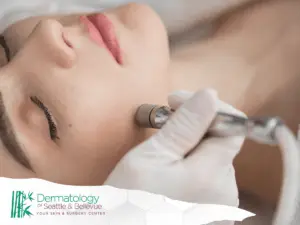
Microneedling
Microneedling uses fine needles to create controlled micro-channels in the skin, stimulating collagen and elastin. On its own, it offers:
- Firmer, more resilient skin
- Improved fine lines and mild scarring
- Better absorption of medical-grade serums
When paired with radiofrequency or growth-factor serums, it becomes a powerful collagen-builder that helps the skin “hug” the underlying structure more tightly.
Dermal Fillers
Fillers don’t literally “lift” skin the way surgery does, but they can reposition facial volume in a way that mimics lift. By carefully placing hyaluronic acid fillers or other injectables in key support areas—cheekbones, temples, chin, jawline—we can:
- Rebuild flattened cheeks that contribute to jowls
- Sharpen the jawline
- Soften deep folds around the mouth
This is sometimes called a “liquid facelift.” Done well, it should look like you on a very good day—not overfilled or artificial. Exploring SmoothGlo’s innovative approach can help individuals achieve that natural glow while enhancing their features in a subtle way. By utilizing advanced techniques and high-quality products, the results can be both rejuvenating and harmonious with one’s facial structure. Ultimately, the goal is to achieve a refreshed look that enhances confidence without compromising authenticity.
What Can I Use to Lift My Face?
Many people come in asking, “What can I use to lift my face without surgery—and do any of the at-home gadgets actually work?” The truth is that home care plays a helpful supporting role, but it will not replace in-office devices or injectables for real lifting.
At-Home Remedies
Home strategies are best for maintaining skin health and slowing future sagging:
- Consistent sunscreen use – UV damage is one of the biggest drivers of collagen loss. Daily SPF 30+ is still your best “anti-sagging” tool.
- Prescription or medical-grade retinoids – Stimulate collagen, thicken the dermis, and soften fine lines over time.
- Gentle facial massage and lymphatic drainage – Can reduce puffiness and help define features temporarily, but does not permanently lift stretched skin.
- Healthy lifestyle habits – Sleep, nutrition, and avoiding smoking all impact how firm your skin remains over the years.
These steps keep your skin in its best possible condition, but they are subtle; they won’t recreate what Ultherapy, RF, or expertly placed fillers can do.
Over-the-Counter Products
Many creams and tools are marketed as a “face lift without surgery.” Most provide:
- Short-term tightening from film-forming ingredients or caffeine
- Improved glow and texture from moisturizers and exfoliants
- Very modest collagen support from peptides or growth-factor mimics
They’re not useless—but they should be seen as maintenance, not as your primary lifting strategy. If a product promises surgical-level results, it’s usually advertising, not science.
h2 Benefits of Choosing Non-Surgical Options
When someone is a good candidate, non-surgical facelifts can offer meaningful improvements with far less disruption than surgery. That’s why many Bellevue patients start here first.
Lower Cost Compared to Surgery
A surgical facelift is a major investment that includes surgeon’s fees, anesthesia, facility costs, and time off work. Non-surgical options are typically:
- Paid per session or package
- Easier to phase over months or years
- Flexible enough to adjust as your face changes with age
Over a lifetime, you may still invest significantly in maintenance treatments, but you can spread the cost out and tailor it to your goals and budget.
Minimal Downtime
Most non-surgical facelift treatments:
- Take 30–90 minutes in the office
- Involve little to no time away from work or social activities
- Cause only mild, temporary swelling, redness, or bruising
That makes them ideal for people with busy schedules, caregivers, or anyone who can’t commit to weeks of recovery.
Natural-Looking Results
Non-surgical techniques are designed to enhance your features, not replace them. With careful planning, we can:
- Preserve your natural expressions
- Avoid the “over-pulled” or “overfilled” look
- Make changes gradual, so friends just notice that you look rested and refreshed
When done conservatively, you should look like yourself—simply a bit more lifted, smoother, and brighter.
Choosing the Right Provider
Because a “face lift without surgery” usually involves multiple techniques, your choice of provider matters more than the specific device. You want someone who can evaluate your entire face, not just operate a machine.
Questions to Ask
- What combination of treatments do you recommend for my specific concerns?
- How many of these procedures have you personally performed?
- What kind of results can I realistically expect, and how long will they last?
- What are the risks, side effects, and downtime for each option?
- How often will I need maintenance, and what will that cost over time?
Ask to see before-and-after photos of patients with a similar age, skin type, and degree of laxity. This gives you a clearer sense of what’s achievable.
Importance of Consultation
A proper consultation should include:
- A detailed facial analysis (skin quality, fat pads, ligaments, bone structure)
- Review of your medical history and medications
- Discussion of your tolerance for needles, downtime, and maintenance
- A stepwise plan—starting with the most impactful treatments first
Occasionally, after examining your facial structure, I’ll recommend surgical consultation instead of non-surgical options. That’s not a failure; it’s about steering you toward the approach that genuinely fits your anatomy and expectations.
Conclusion
Non-surgical facelift options have come a long way. For the right candidate, treatments like Ultherapy, radiofrequency, laser resurfacing, microneedling, and carefully placed fillers can noticeably lift, contour, and refresh the face without incisions or extended downtime.
If you’re in Bellevue and wondering whether a face lift without surgery is realistic for you, the best next step is a personalized evaluation. Together we can map out whether non-surgical tightening is enough—or whether you’re approaching the point where surgery will give you a better return on investment.
Disclaimer
This information is for educational purposes only and does not replace a consultation with a licensed dermatologist or facial plastic surgeon. Any procedure—surgical or non-surgical—carries risks that must be reviewed individually. Never start, stop, or change treatments based solely on online information.